October 15th, 2009 by jkonovsky Comments Off
October 15th was one of two days this year that the shellfish industry picked up garbage on beaches in South Sound. Four Choice High School students and their leader, John Johnson pitched in to clean up debris on the Twin River Ranch tidal marshland at the head of Oakland Bay.

In the phot0, Michael Hooton shows off the garbage pile. Taylor Shellfish will bring a boat in later in the day at high tide to collect the garbage for disposal.
This is the first time garbage has been picked up in the Twin River Ranch tidal marshlands. The effort was spurred on by the pending acquisition of the property by the Capitol Land Trust. The land trust intends to maintain the property for its fish and wildlife habitat value.
Tags: Uncategorized
October 14th, 2009 by jkonovsky Comments Off
Tags: Uncategorized
October 12th, 2009 by Joseph Peters Comments Off
Video of Squaxin Island Tribe Fish Techs Danny Snyder and Bear Lewis sampling the Tribes coho commercial fishery.
Commercial sampling video
Video recorded and provided by Emmett O’Connell, South Sound Information and Education Officer, NWIFC.
Tags: Salmon
September 21st, 2009 by Joseph Peters

Lee Pilon of WDFW collecting Male Chinook milt.
On Monday September 21, WDFW staff with some help from Squaxin NR staff began spawning approximatly 100 female and 100 male Chinook at the Tumwater Falls Hatchery.

Will Henderson sorting male and female chinook for spawning


Joe Peters sorting male and female chinook

An estimated 500,000 eggs were taken and milt from 100 males to Minter Creek Hatchery for fertilization. Eventually these fertilized eggs will return to Tumwater Falls Hatchery as Fry.
All spawned fish and surplus fish went to a food bank.
If you have time go check out the spawning of the Chinook Mondays, Wednesdays and Fridays around 8 am to 11 am at the Tumwater Falls Hatchery for the next couple of weeks.

Joe Peters and Will Henderson taking a break from sorting fish
Tags: Uncategorized
September 21st, 2009 by Joseph Peters · 1 Comment

Ocean sunfish or Mola mola are a rare find in the Puget Sound. These fish are generally found worldwide in temperate and tropical seas. They feed primarily on jellyfishes. Although the photo above is a small Ocean sunfish, they can get up to 2 meters in length and are known as the heaviest bony fish reaching over 2 tons.
For more information on Ocean sunfish (Mola mola):
Fish Base: Mola mola
Ocean sunfish photos
Starfish: sunfish
UW/ichthyology/Fishkey
Tags: Uncategorized
September 15th, 2009 by Joseph Peters
From Northwest Indian Fisheries Commission Website:
The treaty tribes of western Washington look forward to continuing to work with Phil Anderson as director of the Washington Department of Fish and Wildlife (WDFW).
Anderson was named the department’s permanent director Saturday by the nine-member commission….(read more at NWIFC website).
Tags: Salmon · Shellfish · Water Quality · habitat
September 4th, 2009 by jkonovsky
Photos courtesy of Taylor Shellfish staff and Phil Rousseau, a Simpson retiree. See also: http://picasaweb.google.com/clharrismeister/Orcas09?authkey=Gv1sRgCMzrlq-HwJngdA&feat=email# .


Tags: Uncategorized
August 31st, 2009 by esparkman
Tags: Shellfish
August 18th, 2009 by Joseph Peters

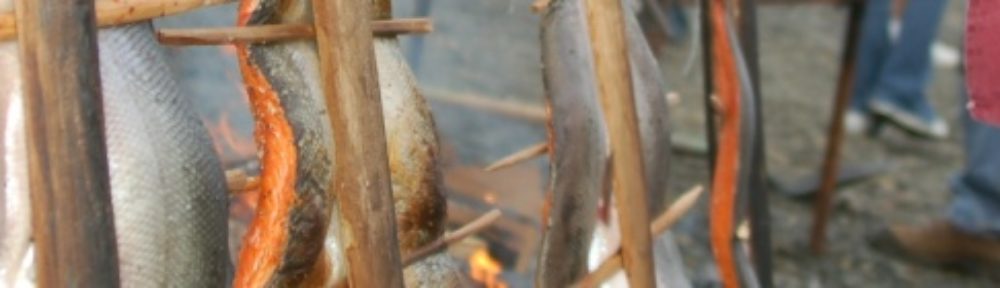
Jim Peters traditionally cooks Chinook at the Squaxin First Salmon Ceremony. Photo by Emmett O'Connell-NWIFC
Shelton Mason County Journal Video Slide Show
The First Salmon – As told by Cecil Cheeka
Once there was a little boy, and he loved salmon. He played with salmon and he swam with salmon. Finally the salmon people decided to take him home with them. He wanted to go, so they took him to the land where the salmon people live.
He lived there for several months or maybe even years. The boy began to get homesick, so the salmon people agreed to take the boy back to visit his family. The salmon people knew they were coming for two reasons – to bring the little boy back to his family and to bring them food. Messages were sent so the family would know what time of year the salmon people were coming.
And so they prepared real carefully, cleaning the streams and cleaning the beaches, preparing for the salmon boy and the salmon people to come. The family had the ferns and the moss all ready and waiting. And they caught the first salmon, cleaned him real carefully, made sure everything was taken care of real nice, and then cooked the salmon.
But before they cooked the salmon, they took the skeleton, very carefully and very ceremoniously, back down to the beach. They placed the skeleton upstream to show the direction for the rest of the salmon people who were bringing the boy back for a visit. The message was clear that the family of the boy was taking very good care of the salmon that were coming back.
Every year they still come back to visit and it is very important for us to make sure that they are welcome, taken care of and everything is waiting for them, including clean beaches and streams.
Tags: Salmon
August 10th, 2009 by jkonovsky

State and Tribal scientists use fecal bacteria (FC) as an indicator of water pollution in Oakland Bay. In 2006 during the summer months, the bacteria concentration in the water column at the head of Oakland Bay skyrocketed and restricted commercial harvest in some shellfish beds. In in the first half of the summer of 2009, the concentrations are much lower, in spite of the hot weather we have had and a massive die-off of clams earlier in the year. That’s good news for the Tribe, the shellfish industry and the greater community.

The low fecal bacteria concentrations in the water column are not matched by lower concentrations in or on the intertidal sediment. Sediment bacteria concentrations are running higher this year than in 2007 or 2008. But for some reason, the bacteria are not being resuspended into the water column. This resuspension often occurs when wind speed exceeds 5 mph from the southwest creating extensive wave action in the upper bay that stirs up the bacteria-laden sediment.

At the end of the summer, we will analyze more data including wind speed and direction to try and explain this year’s fecal bacteria counts.
Tags: Uncategorized